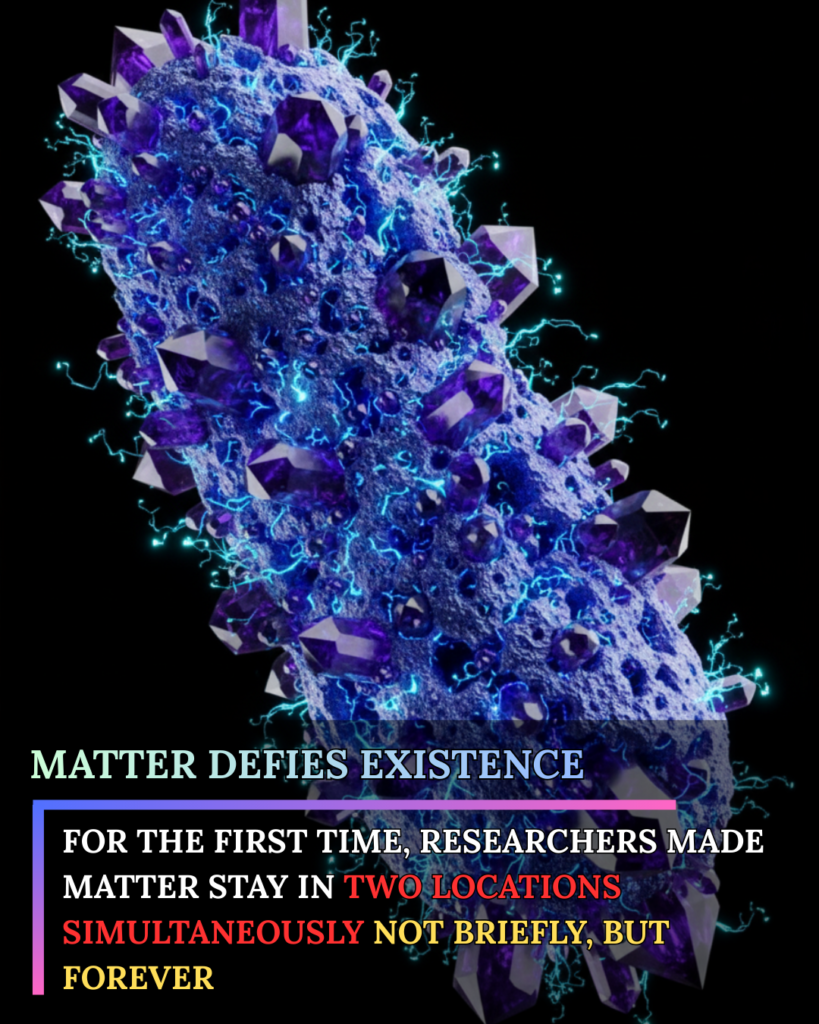
Long-lived quantum superposition in physics represents a significant advancement in understanding the quantum world. Quantum superposition allows matter to exist in multiple states simultaneously, a phenomenon traditionally observed only under highly controlled laboratory conditions and for very short durations. Recent experimental developments suggest that these superposition states can now be maintained for extended periods, opening new opportunities for quantum computing, materials science, and fundamental physics research.
This article explains the concept of long-lived quantum superposition, how researchers achieve it, its practical and theoretical implications, and current limitations. It also addresses common misconceptions and provides a factual, educational overview suitable for general readers and professionals alike.
Understanding Quantum Superposition
What Is Quantum Superposition?
Quantum superposition is a fundamental principle of quantum mechanics. It describes the ability of a quantum system to exist in multiple possible states at the same time until an observation or measurement collapses it into a single outcome.
Key points:
- An electron can occupy multiple energy states simultaneously.
- Particles can exhibit both wave-like and particle-like behaviors.
- Quantum bits (qubits) can encode both 0 and 1 at the same time.
This behavior is mathematically represented by a wave function, which encodes all possible states of a system.
Why Superposition Is Usually Fragile
In most environments, quantum superposition is highly sensitive and short-lived. Interactions with the environment, such as heat, electromagnetic radiation, or atomic collisions, cause decoherence, collapsing the system into a definite state.
Main sources of decoherence include:
- Thermal vibrations
- Electromagnetic interference
- Collisions with surrounding particles
- Material defects in experimental setups
Maintaining superposition beyond microseconds has historically been one of the greatest challenges in experimental quantum physics.
How Long-Lived Superposition Is Achieved
Extreme Environmental Control
Scientists achieve long-lived superposition through precise isolation and control of the quantum system. Techniques include:
- Ultra-low temperatures near absolute zero.
- Vacuum environments to minimize particle interference.
- Electromagnetic shielding to prevent noise from collapsing the state.
- Engineered quantum materials with minimal defects to reduce internal disturbances.
These methods drastically reduce decoherence, allowing superposition states to persist for much longer than previously possible.
Quantum Error Correction
Quantum error correction enables the maintenance of superposition over extended periods without direct measurement.
Core principles:
- Encoding quantum information across multiple qubits.
- Using entanglement to detect inconsistencies in states.
- Applying corrective operations automatically to stabilize the system.
This approach allows systems to remain coherent even when small environmental disturbances occur.
Experimental Platforms
Several platforms demonstrate long-lived superposition:
- Superconducting quantum circuits: Strongly controlled electrical systems with long coherence times.
- Trapped ions: Ions suspended in electromagnetic traps that maintain coherence for milliseconds to seconds.
- Neutral atoms in optical lattices: Arrays of atoms held in place by lasers for controlled experiments.
- Photonic systems: Light-based setups with minimal decoherence and potential for communication applications.
Internal links could point here to detailed comparisons of quantum platforms for readers seeking technical insight.
Significance of Long-Lived Quantum Superposition
Implications for Quantum Computing
Stable superposition is critical for quantum computing. Longer coherence times allow qubits to process more complex computations efficiently.
Potential benefits:
- Enhanced simulation of molecular and chemical systems.
- Faster solutions for optimization problems.
- Improved cryptography methods using quantum algorithms.
Without stable superposition, quantum computing cannot reliably outperform classical computing systems.
Impact on Fundamental Physics
Long-lived superposition allows physicists to probe the foundations of quantum mechanics:
- Understanding the quantum-to-classical transition.
- Investigating whether gravity affects quantum state collapse.
- Testing the feasibility of macroscopic superposition.
These experiments refine theoretical models and may guide future discoveries in quantum physics.
Applications Beyond Computing
Long-lived superposition also has practical applications:
- Quantum sensing: Ultra-precise measurements of time, magnetic fields, and gravitational effects.
- Materials science: Creating novel quantum states for innovative materials.
- Quantum communication: Secure data transmission using quantum key distribution.
Internal links to quantum sensors or quantum communication articles would enhance SEO and user engagement.
Common Misconceptions and Limitations
Are Everyday Objects in Superposition?
No. Laboratory superposition occurs under extreme conditions. Ordinary objects constantly interact with the environment, causing immediate decoherence. Macroscopic superposition remains theoretical.
Is Superposition Truly Permanent?
“Long-lived” does not mean infinite. It refers to stability over experimentally relevant timescales, often maintained with active error correction and environmental control.
Technical and Practical Constraints
Current limitations include:
- High experimental complexity and cost.
- Limited scalability of quantum systems.
- Ethical considerations related to quantum cryptography and security.
Ongoing research focuses on overcoming these challenges while ensuring safety and reproducibility.
Best Practices for Interpreting Quantum Research
Evaluating Scientific Claims
Checklist for readers:
- Confirm peer-reviewed publication.
- Verify replication by independent groups.
- Check for clear distinction between theory and experiment.
- Assess credibility of the institutions involved.
Avoid sensationalized headlines, which often misrepresent complex findings.
Long-Term Research Considerations
Sustained progress requires:
- Investment in basic research and infrastructure.
- Interdisciplinary collaboration across physics, engineering, and computer science.
- Transparent methodologies and reproducibility standards.
These steps ensure breakthroughs lead to reliable and practical applications.
Frequently Asked Questions (FAQ)
What does long-lived quantum superposition mean?
It refers to the ability of a quantum system to remain in multiple states simultaneously for extended periods under controlled conditions.
Has permanent superposition been proven?
No. Experiments have achieved long-lived superposition, but absolute permanence is not possible with current technology.
Does this change classical physics?
Classical physics still governs everyday phenomena. Quantum superposition extends understanding at microscopic scales, complementing rather than replacing classical models.
Are there practical applications now?
Yes. Quantum computers, sensors, and secure communication systems already utilize stable superposition.
Does observation always collapse a quantum state?
Direct measurement typically collapses a quantum state, though indirect techniques can delay or mitigate this effect.
Conclusion
Long-lived quantum superposition represents a major milestone in understanding and controlling the quantum world. By maintaining matter in two states simultaneously for extended periods, researchers have unlocked new opportunities in computing, sensing, and fundamental physics. While challenges remain, ongoing research continues to refine our understanding of quantum mechanics and its applications. Readers interested in further exploration may consult related articles on quantum computing, quantum decoherence, or experimental quantum platforms.
SOURCE
- National Institute of Standards and Technology (NIST), Quantum Coherence and Decoherence, 2023
- Massachusetts Institute of Technology, Advances in Quantum Computing Research, 2024
- Nature Physics, Long-Lived Quantum Superposition in Engineered Systems, 2022
- IBM Research, Quantum Error Correction: Principles and Applications, 2023
- CERN, Foundations of Quantum Mechanics, 2021